If you’ve ever looked at the maze of truck towing regulations and felt overwhelmed, you’re not alone. Between federal DOT requirements, state-specific permits, weight restrictions, and timing limitations, the rules for legally towing commercial trucks can feel impossibly complex. At Zielke Towing & Tire, we’ve been navigating these regulations for years across Southwest Michigan, and we’re here to break it all down in plain English.
Whether you’re a truck owner dealing with a breakdown, a fleet manager planning heavy equipment transport, or someone who just needs to understand what’s legally required when moving a commercial vehicle, this guide will walk you through everything you need to know about truck towing permits and regulations.
Why Towing Permits and Regulations Matter
Let’s start with the most important question: why do all these rules exist in the first place?
Truck towing regulations aren’t just bureaucratic red tape. They exist to protect everyone on the road—including you, your cargo, other drivers, and the infrastructure we all depend on. When trucks exceed standard legal limits for weight, width, height, or length, they can damage roads and bridges, create safety hazards for other motorists, and risk serious accidents if not handled properly.
The consequences of operating without proper permits are real and expensive. You could face hefty fines, have your vehicle placed out of service, damage roads or bridges and be held liable, or cause accidents that put lives at risk. Beyond the immediate penalties, violations can affect your safety ratings, insurance rates, and business reputation.
Here’s the thing we want you to understand: these regulations aren’t designed to make your life harder. They’re designed to make transportation safer and more predictable for everyone. When you’re compliant, you’re not just avoiding fines—you’re contributing to a safer transportation system.
Understanding U.S. DOT and Federal Regulations
Before we dive into specific permit types, let’s talk about the federal framework that governs commercial truck towing across the entire country.
Federal Motor Carrier Safety Administration (FMCSA) Overview
The Federal Motor Carrier Safety Administration (FMCSA) regulates and oversees the trucking industry, including towing, with the goal of reducing crashes, injuries, and fatalities involving trucks and buses. The FMCSA is directly responsible for federal programs that impact towing companies, including driver qualifications, hours of service, safety regulations, and vehicle inspection requirements.
Every towing company operating commercial vehicles must comply with these federal regulations, regardless of which state they’re operating in. That means understanding FMCSA rules is your baseline—then you add state-specific requirements on top.
When You Need a DOT Number
DOT mandates may apply when towing if the Gross Combination Weight Rating (GCWR) is greater than 10,000 pounds. This is a critical threshold that many people don’t realize applies to them.
Here’s where it gets tricky: operators can drive three-quarter-ton or half-ton pickups without requiring a DOT sticker if there’s no trailer attached, but adding a trailer may put the vehicle over the 10,001-pound GCWR regulation limit. The moment you’re towing something, even a small trailer, your combined weight rating matters.
You’ll need a USDOT number if your vehicle transports more than eight people (including the driver) for compensation, transports certain quantities of hazardous materials requiring placarding, or operates with a GVWR or GCWR of more than 10,000 pounds in interstate commerce.
Driver Qualification Requirements
The majority of tow truck drivers must possess a valid Commercial Driver’s License (CDL) and be in good health to operate a commercial truck. Beyond the CDL, drivers must complete written tests and possess the necessary driving skills to obtain required licensing and certificates.
For towing companies, fleet managers must maintain driver qualification files that include the driver’s employment application, verification of personal identification, driver’s record, a copy of the driver’s CDL and any training or certificates, drug test results, and driving logs showing daily hours driven.
Federal Safety Equipment Standards
The DOT has rules governing how tow truck drivers secure and restrain disabled vehicles to be towed, including using appropriate straps and chains, performing proper tie-down procedures, and inspecting the towed vehicle thoroughly before transporting.
Additionally, tow truck drivers are required to wear high-visibility garments and reflective gear, and the federal government requires emergency responders working near or on a federal highway to wear fluorescent safety vests in orange, yellow, or green.
Types of Towing Permits You Need to Know About
Now let’s get into the specific permits you might need when towing commercial trucks or heavy equipment. Understanding which permit applies to your situation is crucial for staying legal and avoiding delays.
Oversize Load Permits
Oversize permits are required when your vehicle or load exceeds standard legal dimensions. In Michigan, standard legal limits are width of 8 feet 6 inches, height of 13 feet 6 inches, and a maximum length for truck-semi-trailer combinations of 65 feet.
If you’re exceeding these dimensions, you need an oversize permit before you hit the road. The permit will specify your approved route, travel times, and any special requirements like escort vehicles or specific signage.
Oversize permits come in two main types: single trip permits and extended permits. Single trip permits may be issued for a five-day period and are valid for one trip, though a return move may be requested on the same permit within that five-day period. Extended permits may be issued on an annual basis based on the vehicle or load being transported, with various categories including construction, miscellaneous, agricultural, pipe and pole, and modular or mobile home permits.
Overweight Permits
Overweight permits are separate from oversize permits and are required when your vehicle exceeds legal weight limits. In Michigan, standard legal weight limits are 20,000 pounds on a single axle, 34,000 pounds on a tandem axle, and a maximum gross weight of 80,000 pounds.
Here’s something important to understand: permits are not issued or valid for divisible loads that can be readily dismantled, reduced, or otherwise rearranged to come within legal limits. If your load can be broken down into smaller pieces, you’re expected to do so rather than getting an overweight permit.
Weight distribution matters significantly. Even if your total weight is within limits, improper distribution across axles can create violations. Professional towing companies understand bridge formulas and axle spacing requirements that affect how weight must be distributed.
Trip Permits for Interstate Travel
Michigan operators eligible for apportioned registration must have a trip permit to enter any IRP (International Registration Plan) jurisdiction unless the Michigan vehicle has an apportioned registration with that jurisdiction listed on the cab card.
For out-of-state trucks entering Michigan, a 72-hour reciprocity permit is required for the power unit of a truck registered in a jurisdiction not reciprocal with Michigan, or a truck from a reciprocal jurisdiction but exceeding its maximum GVW while in Michigan. The fee for each 72-hour permit is $20.
Fuel Permits
A Temporary Fuel permit is issued in lieu of IFTA licensing for travel within Michigan. While this might seem like a minor detail, operating without proper fuel tax documentation can result in significant penalties.
Escort Vehicle Requirements
Some oversized or overweight loads require escort vehicles (also called pilot cars) to travel safely. The requirements vary based on the dimensions of your load.
In Michigan, an escort vehicle must be a passenger car or pickup truck with at least one flashing or rotating light on top of the cab. The specific requirements for when escorts are needed depend on your load’s width, height, length, and weight, and these details will be specified on your permit.
Generally speaking, wider loads, longer loads, and loads that will need to use opposing traffic lanes require escort vehicles. Your permit will specify exactly what’s required.
Michigan State-Specific Towing Regulations
Since Zielke Towing & Tire operates in Southwest Michigan, let’s talk specifically about what you need to know for operating in our state.
Michigan Dimensional and Weight Limits
We touched on this earlier, but let’s be more specific. Michigan legal limits before requiring permits are 8 feet 6 inches wide (8 feet on non-designated highways), 13 feet 6 inches high, and 65 feet for truck-semi-trailer combinations.
For weight, single axles are limited to 20,000 pounds on designated highways (18,000 on other roads), tandems to 34,000 pounds (39,000 on non-designated), and tridems to 42,000 pounds (39,000 on non-designated).
Spring Weight Restrictions in Michigan
Here’s something crucial if you’re operating in Michigan: seasonal weight restrictions. During the spring weight restriction period (typically February through April), no overweight permits are issued except in cases of public emergency, and no more than 11 axles are allowed during this period.
Single trip permits will not be issued for overweight loads or loads exceeding 14 feet in width, 11 axles, and 150 feet in overall length in the weight-restricted area. Maximum axle weights may be reduced up to 35% during this period.
Why? During spring thaw, a soft layer below the pavement and above the frost line can create weakness in the pavement. Michigan protects its road infrastructure by implementing these temporary restrictions when roads are most vulnerable.
If you need to move heavy equipment during this period, planning ahead is essential. We work with clients months in advance to schedule moves before or after the restriction period.
Travel Time and Holiday Restrictions
Permits in Michigan are issued for daylight hours only (Monday through Friday), defined as one-half hour before sunrise to one-half hour after sunset.
There’s a limited exception: weekend movement is permitted on a trial basis for loads not exceeding 10 feet in width, 14 feet high, and 90 feet long, allowed all day Saturday and until 3:00 PM on Sunday. Mobile and modular homes are not eligible for weekend movement.
Permits are not valid starting noon the day before and continuing through dawn of the day after major holidays including New Year’s Day, Memorial Day, Independence Day, Labor Day, Thanksgiving Day, and Christmas Day. When holidays fall on Friday or Monday, restrictions extend to cover the entire three-day weekend.
Rush Hour Restrictions
Loads over 12 feet wide or 90 feet long are not permitted to move from 7:00 AM to 9:00 AM and from 3:00 PM to 6:00 PM in the following counties: Genesee, Ingham, Jackson, Kalamazoo, Kent, Muskegon, Macomb, Oakland, Saginaw, Washtenaw, and Wayne.
These restrictions exist to prevent oversized loads from creating traffic congestion during peak commute times in Michigan’s most populated areas.
Required Signage and Safety Equipment
Michigan requires “OVERSIZE LOAD” signs on the front bumper of the truck and on the rear of the trailer for any over-dimensional freight, with sign dimensions of 5 feet long, 12 inches high, and 8-inch-high black letters on a yellow background.
If the overhang is 4 feet or more, you must display a 12-inch red square flag at the extreme rear of the load during daytime and a red light or lantern at night.
An overwidth or overlength vehicle/load requires flags at each corner of the load, with an additional flag at the widest point on each side of the load if it extends beyond the corner flags.
Michigan Permit Application Process
The MDOT Permit Gateway (MPG) is the official portal for ordering and renewing permits, using the Michigan Transport Routing and Internet Permitting (MiTRIP) system.
Electronically submitted single trip permits are processed in the order received and are usually issued within 12 business hours, though incomplete or inaccurate information may delay issuance. Permits can be applied for up to seven business days ahead of time.
Payment must be made at the time of application through credit card, debit card, or electronic check. MDOT no longer bills accounts for transport permits.
When You Need Permits and How Zielke Towing Helps
When You Legally Need a Towing Permit
Understanding when permits are required versus when they’re optional can save you time, money, and legal headaches. Let’s break down the specific scenarios.
Commercial vs. Private Towing
The type of towing operation affects your permit requirements. If you’re operating a commercial towing business and being compensated for towing services, you’re subject to more stringent regulations than someone towing their own disabled vehicle.
Commercial operations require DOT numbers, proper insurance, driver qualification files, and compliance with hours-of-service regulations. Private individuals towing their own vehicles within legal size and weight limits typically don’t need special permits, though they still must comply with safety requirements.
Accident Recovery and Emergency Situations
Accident recovery presents unique regulatory considerations. In emergency situations, some states allow limited exceptions to certain permit requirements to quickly clear roadways and restore traffic flow.
However, this doesn’t mean anything goes. Even in emergency situations, safety equipment requirements, securement standards, and basic DOT regulations still apply. The goal is to move the disabled vehicle safely to the nearest secure location—not to transport it across state lines without proper permits.
Weight Thresholds That Trigger Permit Requirements
As we discussed earlier, the 10,000-pound GCWR threshold is critical. Once you exceed this in interstate commerce, federal DOT regulations apply. But state permit requirements often have different thresholds.
For Michigan specifically, permits are required when exceeding 80,000 pounds gross vehicle weight, though the actual requirement depends on axle configuration and weight distribution. A vehicle might be legal at 85,000 pounds with proper axle spacing but illegal at 75,000 pounds with poor weight distribution.
Dimensional Triggers
Any time your vehicle or load exceeds standard legal dimensions—8’6″ wide, 13’6″ high, or specified length limits—you need a permit. There’s no gray area here. Even exceeding limits by a few inches requires a permit.
Height is particularly important because the consequences of getting it wrong are severe. If you claim 13’6″ but you’re actually 13’8″ and you hit a bridge, you’re liable for potentially millions of dollars in damage plus any injuries or deaths that result.
What Zielke Towing & Tire Handles for You
Here’s where working with an experienced professional towing company makes all the difference. When you call Zielke Towing & Tire for commercial truck towing or heavy equipment transport, you’re not just getting a truck and a driver—you’re getting expertise in navigating this entire regulatory landscape.
Permit Management and Compliance
We handle the permit application process from start to finish. That means we determine which permits you need based on your specific vehicle, load, route, and timing. We submit applications through the proper state portals with accurate information to avoid delays. We ensure permits are obtained with enough lead time before your scheduled move. We keep copies of all permits with the towing vehicle and the load, and we monitor permit expiration dates and travel time windows.
For clients with regular transport needs, we can help you determine whether annual extended permits make sense versus single-trip permits.
Route Planning and Compliance
One of the most valuable services we provide is route planning that accounts for all regulatory requirements. We identify routes that accommodate your load’s dimensions, avoiding low bridges, narrow roads, and restricted areas. We plan around rush hour restrictions in applicable counties. We schedule moves to comply with time-of-day and day-of-week restrictions. We identify any local jurisdiction permits needed beyond state permits. We coordinate with utilities or authorities when overhead clearances are tight.
The route specified on your permit isn’t optional—it’s the only legal route you can travel. Deviating from your permitted route, even to avoid traffic, can result in violations. We make sure you’re on the right roads at the right times.
Escort and Pilot Car Coordination
When your load requires escort vehicles, we coordinate that service as well. We maintain relationships with certified escort vehicle operators throughout Michigan and surrounding states. We ensure escort vehicles meet all equipment requirements (proper lighting, signage, communication equipment). We brief escort operators on the specific requirements of your move. We coordinate timing so escorts are in position when needed.
The number and kind of pilot cars needed for a given shipment changes situationally, and in some instances, over-height shipments will require pole cars—a type of pilot car with an extendable pole on the front—to ensure visible clearance of the loaded height prior to passing underneath structures.
Communication with State Authorities
Sometimes moves require coordination with state transportation departments, bridge authorities, or local law enforcement. We handle these communications on your behalf, ensuring all necessary parties are notified and requirements are met.
For example, certain bridge crossings require advance notice and may provide escorts. We make those arrangements so you don’t have to worry about the details.
Equipment and Safety Compliance
Our towing equipment meets or exceeds all DOT requirements. That means properly rated chains, straps, and securement equipment; vehicles with appropriate gross vehicle weight ratings for the loads we’re towing; proper lighting and reflectors meeting federal standards; and safety equipment including flags, signs, and warning devices.
We also ensure our drivers have all required certifications, current medical cards, clean driving records, and training on securement and safety procedures. Whether you need heavy-duty towing, medium-duty towing, or light-duty towing, we have the right equipment and expertise.
Industry Safety Standards and Best Practices
Beyond just meeting minimum legal requirements, professional towing companies follow industry best practices that enhance safety and protect everyone involved.
Securement and Tie-Down Standards
Proper securement isn’t just about legal compliance—it’s about preventing catastrophic failures. We follow established standards for the number of tie-down points based on load weight and length, proper positioning of chains and straps to distribute forces evenly, appropriate tension in securing devices without over-stressing equipment, and protection of load and securement points from damage.
Pre-Trip Inspection Requirements
Tow truck operators are required to maintain their vehicles regularly and keep thorough records of all repairs and inspections. Before any commercial towing operation, a thorough pre-trip inspection is required, covering towing equipment, vehicle systems, lights and signals, tires and wheels, brakes and suspension, and load securement.
Any problems detected during inspection must be addressed before the vehicle operates. This isn’t optional—it’s a federal requirement designed to prevent equipment failures that could cause accidents.
Weather and Road Condition Considerations
Michigan weather presents unique challenges. Winter snow and ice, spring thaw and soft roads, summer storms with high winds, and fall fog and reduced visibility all affect safe towing operations.
We monitor conditions and make go/no-go decisions based on safety, not just what’s legal. Sometimes that means delaying a move even when permits are valid because conditions make it unsafe to proceed.
Night Travel Restrictions and Lighting
Most oversize and overweight permits restrict movement to daylight hours for good reason—visibility is critical for safety. When continuous travel is permitted for certain loads, enhanced lighting requirements apply.
Michigan requires a minimum of two flashing amber lights on the rear of the vehicle, and all flashing or rotating amber lights must be visible for a distance of 500 feet.
Permit Costs and Processing Timelines
Let’s talk about the practical matters of what permits cost and how long they take to obtain.
Cost Factors
Permit fees vary widely based on several factors including the type of permit (single trip vs. extended), the dimensions and weight of your vehicle or load, the distance you’re traveling, whether you need multiple state permits for interstate travel, and whether you need escort vehicles.
In Michigan, fees are structured to cover the cost of administering the permit program. Extended annual permits are pro-rated based on when they’re issued and when they expire.
It’s important to understand that permit fees are just one cost component. You’ll also need to factor in potential costs for escort vehicles, route surveys for extremely large loads, special insurance requirements, and the time value of complying with travel restrictions.
Application Lead Time
In Michigan, electronically submitted single trip permits are usually processed within 12 business hours, and permits can be applied for up to seven business days ahead of time.
For complex moves, superloads, or routes requiring special approval, allow significantly more time—weeks or even months for particularly large or complicated moves. If you need permits in multiple states for an interstate move, you’ll need to coordinate timing across jurisdictions, which adds complexity.
Our advice: don’t wait until the last minute. Give yourself buffer time in case applications need corrections or additional information.
Annual vs. Single Trip Permit Economics
If you’re making regular trips with the same vehicle configuration, annual extended permits often make economic sense. The upfront cost is higher, but the per-trip cost is lower, and you avoid the administrative burden of applying for permits repeatedly.
For occasional or one-time moves, single trip permits are more cost-effective. We can help you analyze your specific situation and recommend the most economical approach.
Common Mistakes That Lead to Violations
Over the years, we’ve seen the same mistakes happen repeatedly. Learn from others’ errors and avoid these common pitfalls.
Not Obtaining Permits Early Enough
One of the most frequent mistakes is waiting until the last minute to apply for permits. Remember that processing takes time, and if your application has errors or needs clarification, you’ll face delays.
Starting a move without proper permits because you didn’t apply in time isn’t just illegal—it’s a fast way to get your vehicle placed out of service, face substantial fines, and damage your safety rating.
Using Inadequate or Improper Equipment
Another common error is attempting to tow loads without equipment properly rated for the weight and size. This includes using chains or straps with insufficient working load limits, towing vehicles without adequate GVWR or towing capacity, or improper securement points or methods.
The consequences can range from citations during inspections to catastrophic failures where loads break free, causing property damage, injuries, or deaths.
Miscalculating Weight and Dimensions
Many violations occur because people underestimate their actual weight or dimensions. They might forget to account for the weight of dunnage, securement equipment, or fuel, measure height at the wrong point or fail to account for suspension compression under load, or not properly measure the widest or longest point of the load.
When in doubt, err on the side of caution. It’s better to get a permit you didn’t quite need than to get cited for not having one you did need.
Ignoring Axle Weight Distribution
Total weight isn’t the only consideration—how that weight is distributed across axles matters enormously. Poor weight distribution can result in overweight axle violations even when your gross weight is legal, premature tire or suspension failures, reduced braking effectiveness, and poor vehicle handling characteristics.
Bridge formulas dictate how much weight can be carried based on axle spacing. Professional towing companies understand these formulas and know how to distribute loads properly.
Deviating from Permitted Routes
Your permit specifies an approved route for good reason. That route has been evaluated for clearances, bridge capacities, and road conditions. Deviating from your route, even with good intentions like avoiding traffic, is a violation.
If you encounter an unexpected road closure or condition that requires deviating from your permitted route, you need to contact the permitting authority for approval before proceeding.
Operating During Restricted Times
Time restrictions aren’t suggestions. If your permit says daylight hours only, operating after dark is a violation. If rush hour restrictions apply, moving during those windows is illegal regardless of traffic conditions.
We’ve seen people try to “sneak through” during restricted times, thinking they won’t get caught. It’s not worth the risk. Plan your moves to comply with all timing restrictions.
Frequently Asked Questions About Truck Towing Permits
Let’s address some of the most common questions we hear about truck towing regulations and permits.
“Do I need a permit to tow a commercial truck?”
It depends on the size and weight of what you’re towing and where you’re going. If the disabled truck is within legal dimensions and the combined weight of your tow vehicle and the truck being towed exceeds 10,000 pounds GCWR in interstate commerce, you need DOT compliance even if you don’t need a size/weight permit.
If the truck being towed puts you over dimensional or weight limits, you’ll need appropriate permits. For accident recovery, there may be limited exceptions to immediately clear a roadway, but you’ll need proper permits for transport to a final destination.
“How wide is considered oversize in Michigan?”
In Michigan, anything exceeding 8 feet 6 inches wide on designated highways (or 8 feet on non-designated highways) is considered oversize and requires a permit.
“Can you tow a semi without a permit?”
If the semi-truck is within legal dimensions and weight limits and you’re towing it with properly rated equipment, you might not need a special oversize/overweight permit. However, you still need DOT compliance if you exceed the 10,000-pound GCWR threshold.
For most semi-trucks being towed, the combined weight will exceed 10,000 pounds, so DOT regulations apply. If you’re operating commercially (being paid to tow), you need a DOT number, proper insurance, and driver qualification.
“How do escort vehicles work and when are they required?”
Escort vehicles (also called pilot cars) are safety vehicles that drive ahead of or behind an oversized freight shipment to warn the motoring public when they’re in the vicinity of an oversized load. They help protect the load, the towing vehicle, and other motorists by alerting traffic to the presence of an oversized load, warning when the load needs to use opposing traffic lanes, checking clearances under bridges and overpasses, and communicating with the towing vehicle about road conditions ahead.
Your permit will specify whether escort vehicles are required and how many. Requirements generally increase with load dimensions. Very wide loads (over 14-15 feet) typically require both front and rear escorts. Extremely tall loads may require a “pole car” with a height pole to check clearances before the load attempts to pass under structures.
“What happens if I’m caught operating without proper permits?”
Penalties vary by jurisdiction and the severity of the violation, but can include immediate citations with fines ranging from hundreds to thousands of dollars, your vehicle being placed out of service until compliance is achieved, liability for any damage caused to roads, bridges, or infrastructure, negative impacts on your DOT safety rating, and increased insurance costs or difficulty obtaining coverage.
In extreme cases involving willful disregard for regulations or violations that cause injury or death, criminal charges can apply. It’s simply not worth the risk.
“Do permit requirements change if I’m crossing state lines?”
Absolutely. Each state has its own permit requirements, fees, restrictions, and procedures. An interstate move requires permits from every state you’ll travel through, which means complying with multiple different sets of rules.
Some states have reciprocity agreements, but you can’t assume your Michigan permit is valid elsewhere. Planning interstate moves requires coordinating permits across jurisdictions, which is one reason many companies work with professional permit services or towing companies with interstate experience.
“How long does it take to get emergency towing after a breakdown?”
For emergency roadside service, we typically respond within 30-60 minutes depending on your location and our current call volume. However, if your breakdown involves a vehicle or situation requiring special permits, there will be additional time needed to obtain those permits before we can transport the vehicle to its final destination.
We can often move a disabled vehicle to a nearby secure location quickly under emergency provisions, then handle permit acquisition for longer-distance transport. This gets you off the road safely while ensuring compliance with regulations.
Working with Professional Towing Services: Why It Matters
At this point, you might be thinking, “This is way more complicated than I expected.” You’re right—it is complicated. That’s exactly why working with experienced professional towing services makes such a difference.
Expertise and Experience
We’ve been doing this for years. We know Michigan regulations inside and out, understand federal DOT requirements, have relationships with permitting authorities, and stay updated on regulatory changes. What might take you days of research and phone calls, we handle as routine procedure.
Time Savings
Obtaining permits, planning routes, coordinating escorts, and ensuring compliance takes significant time. For most businesses, that time is better spent on core operations rather than navigating towing regulations.
When you work with us, you make one phone call and we handle the rest. That’s not just convenient—it’s economically smart.
Risk Mitigation
Mistakes in this area can be expensive. Violations, fines, out-of-service orders, damage to infrastructure, and accidents due to improper towing can cost far more than professional towing services.
We carry proper insurance, maintain our equipment to DOT standards, train our drivers thoroughly, and follow all regulations. That protects you from liability and risk.
Equipment and Capabilities
Professional towing operations invest in specialized equipment that most businesses don’t have and can’t justify purchasing. We have properly rated tow trucks and equipment, specialized trailers for different types of loads, securement equipment meeting all standards, and safety equipment and lighting.
Our flatbed towing and wheel lift towing capabilities ensure we can handle various types of vehicles safely and efficiently.
24/7 Availability
Breakdowns and accidents don’t happen on a schedule. We provide 24/7 emergency response because we know you can’t always plan when you’ll need help. Whether you need jump start service, battery service, tire replacement, or vehicle recovery, we’re ready to assist.
Moving Forward with Confidence
Truck towing permits and regulations are complex, but they don’t have to be overwhelming. Understanding the basics—federal DOT requirements, state-specific permits, timing and route restrictions, and safety standards—gives you a foundation for operating legally and safely.
The key takeaways from this guide are simple: permits are required when exceeding legal size or weight limits, planning ahead prevents delays and violations, professional assistance saves time and reduces risk, and safety isn’t just about compliance—it’s about protecting lives.
Whether you’re dealing with an unexpected breakdown, planning to transport heavy equipment, or managing a commercial fleet, Zielke Towing & Tire is here to help. We’ll handle the regulatory complexity so you can focus on what matters most to your business.
The roads we all share are safer when everyone follows the rules. That’s not just good business—it’s the right way to operate. When you need truck towing services that you can trust to handle everything correctly, legally, and safely, we’re just a phone call away.
Contact Zielke Towing & Tire for Professional Truck Towing
If you need commercial truck towing, heavy equipment transport, or just want to talk through your specific situation and understand what permits and procedures apply, reach out to us. We’re happy to answer questions, provide guidance, and offer the professional towing services you need throughout Southwest Michigan.
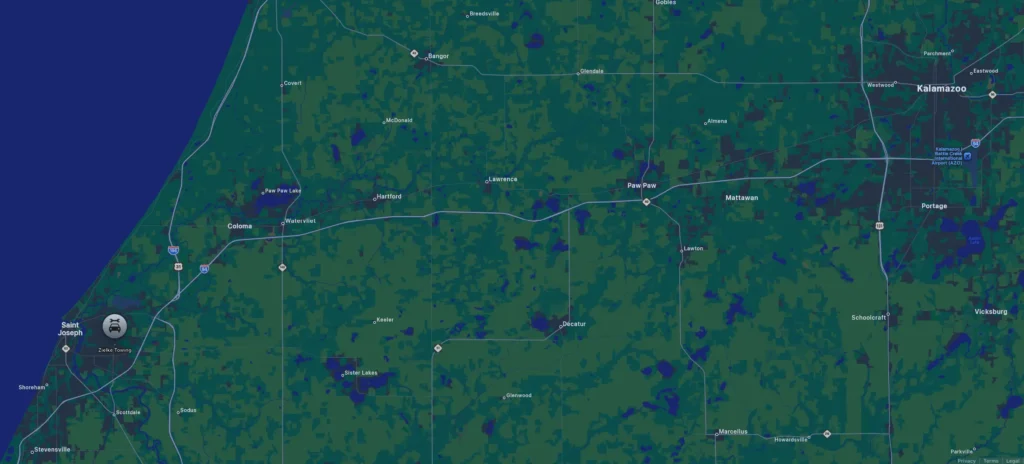
Our team brings decades of combined experience in navigating truck towing regulations, obtaining permits, and safely transporting commercial vehicles and heavy equipment. We serve Kalamazoo, Benton Harbor, Paw Paw, Saint Joseph, and surrounding areas with comprehensive roadside assistance and towing services. Let us put that expertise to work for you.